
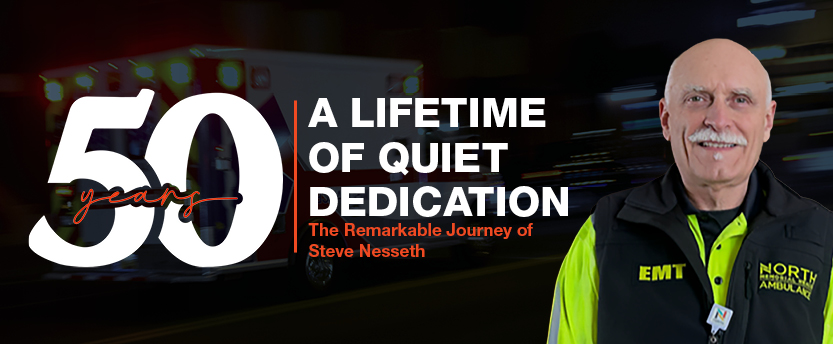
Steve's journey in emergency medical services (EMS) began in the early 1970s, at a time when the field looked very different from what it is today. But for Steve, EMS was never about building a career. It was a calling he embraced alongside his regular full-time job.
EMS has never been how I made a living," he explained. "It's a passion.
In 1973, he first volunteered in his small Minnesota community of Kenyon, responding to emergencies with little more than basic first aid training and a strong desire to help. Ambulance crews were often pieced together through phone trees, equipment was limited, and in some towns, funeral homes still operated the ambulances because no one else would.
There was just such a need," Steve recalled. "You raised your hand, and you helped.
Over time, that need evolved into a dedication. By the mid-1970s, Steve was part of a newly formed, standalone municipal EMS service, separate from police and fire, marking the early development of what we now recognize as modern emergency medicine.
Memorable Calls and Defining Moments
Like many Clinicians with decades of experience, Steve remembers some calls more clearly than others. One of his earliest transports involved taking a critically ill patient from a rural community to St. Mary's Hospital in Rochester, a long drive that would become familiar over the years.But one incident, in particular, stands out as a defining moment. While working as a custodian at Carleton College, Steve witnessed a man he knew collapse during a basketball game, a sudden cardiac arrest happening right in front of him. Unlike most arrests Steve had encountered, this one unfolded in real time. He immediately established an airway while others called for help. Fire rescue and ambulance crews arrived quickly, and the patient was defibrillated and transported to the hospital, later making a remarkable recovery.
The college and the City of Northfield honored Steve for his actions, though he remains characteristically humble about the recognition. "I didn't think I'd done that much," he said. "I just did what anyone would have done."
Balancing Service and Family Life
For much of his life, Steve has served as a volunteer EMT and firefighter, a role that demanded significant personal sacrifice. On-call schedules meant missed dinners, leaving church services early, and stepping away from family events at a moment's notice. In small towns, volunteers often worked entire weekends without compensation unless they were actively on a call.It's a commitment the whole family has to be part of," Steve explained. "You couldn't just leave town unless someone could cover for you.
His daughter Erin described how his service shaped family life. "I remember yelling downstairs to tell him he had a call," she said. "He would grab the pager and run up to the ambulance garage. Weekends, holidays, even during family visits, he was always ready to drop everything to help someone in need."
Despite the challenges, he never questioned whether the commitment was worth it. "EMS has never been about a paycheck," he explained. "It's something I do because I love it. I wouldn't have continued if I didn't enjoy it."
This passion, rather than profession, is a key part of Steve's story and dedication over the past 50 years.
How EMS Has Changed
Few people have witnessed the evolution of EMS as closely as Steve. When he started, oxygen was essentially the only "drug" available to EMTs, and ambulances often arrived at hospitals unannounced because radio communication, though used in larger systems, had not yet reached the rural community where he worked. Today, Steve operates within a major integrated health system, North Memorial Health, supported by advanced equipment, detailed protocols, strong medical direction, and ongoing education. He has seen EMS move from a "load-and-go" model to one focused on on-scene treatment and coordinated patient care."The things paramedics can do now, intubation, medications, cardiac support, we could only dream of 50 years ago," he said.
Advocacy and Leadership
Steve's impact extended beyond the ambulance. In the 1990s, he was appointed by the Governor of Minnesota to serve on the state's Emergency Medical Services Regulatory Board, where he advocated for rural EMS Clinicians and expanded the scope of practice for basic life support services. He believes EMS has historically struggled for recognition because it lacks a unified national voice and exists across hospital-based, private, and municipal systems. Still, he remains hopeful about the future as national organizations begin working more closely together.What Keeps Him Going
After 50 years, Steve says his passion for EMS comes down to one simple idea: caring for people on what may be the hardest day of their lives. "The toughest calls aren't the trauma ones," he reflected. "It's the terminal patients who are scared, who are dying, and there's nothing you can do but talk to them and hold their hand." That philosophy also shapes the advice he gives to new EMTs, "People don't care how much we know. They want to know how much we care."A Rare Milestone
Reaching 50 years of National Registry certification is exceptionally rare, especially in a profession that is only a few decades old. Steve has maintained his National Registry certification throughout his career, not because his employers required it, but because it mattered to him personally. "I earned it," he said. "I wanted to keep it."As Steve begins to think about passing the torch to the next generation, his legacy is evident in five decades of quiet dedication, steady compassion, and unwavering service to patients and communities across Minnesota. For Steve Nesseth, that has always been enough.
Media Contact:
Kelly Schroeder
Manager of Integrated Content & Communications
kschroeder@nremt.org
Guided by our mission to support the EMS profession through partnerships, research, and lifelong assessment of clinical competence, the National Registry was established in 1970 as a non-profit organization and serves as the Nation’s Emergency Medical Services certification organization. It is accredited by the National Commission for Certifying Agencies (NCCA), the accreditation body of the Institute for Credentialing Excellence. The National Registry maintains NCCA accreditation for each of the four certification programs: Emergency Medical Responder (NREMR), Emergency Medical Technician (NREMT), Advanced Emergency Medical Technician (NRAEMT), and Paramedic (NRP). Credentialing protects the public, assures consumers that Clinicians have met standards of practice, advances the EMS profession, and establishes standards of professional knowledge, skills, and practice. Additional information is available at NREMT.org, and BlueSky, TikTok, Facebook, Instagram, LinkedIn, Reddit, and YouTube.