
“This started during COVID-19,” Lee explained. “We built our own EMS, fire, police, and expanded public safety because we needed to meet our community’s needs directly. Once that was in place, we questioned why EMS certification pathways, a step in the pathway to EMS licensure, were still routed through state systems in a way that did not reflect our status as a sovereign nation.”
A Question of Sovereignty and Alignment
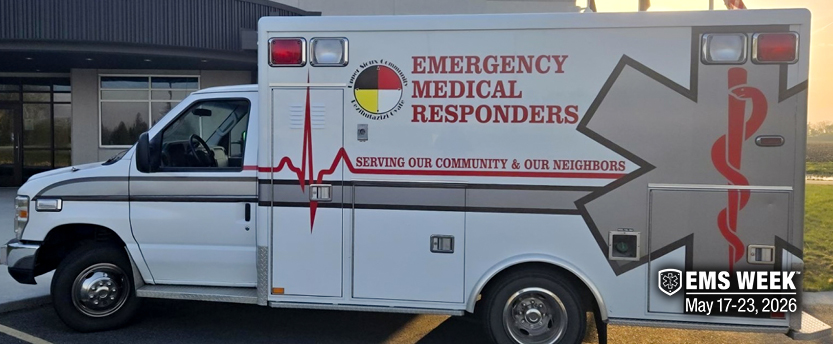
The Upper Sioux Community in southwest Minnesota operates EMS alongside fire, police, public health preparedness, and emergency management. Like many Tribal nations, it maintains a government-to-government relationship with the federal government, yet EMS certification has historically been tied to state licensure pathways.Lee described the disconnect, noting, “It is like the State of Minnesota getting its licensure from Wisconsin. When you look at it that way, it does not align with the sovereignty and authority we already have.”
After reviewing federal statutes and consulting with the Bureau of Indian Affairs and Indian Health Service, Lee confirmed the Tribe could establish its own certification pathway for EMS personnel. The next step was aligning that pathway with national standards.
“We wanted to meet the same standards as everyone else,” Lee said. “National Registry is the gold standard, so aligning with it ensures we are meeting expectations fully.”
A First-of-Its-Kind Model
With approval of the DAA, the Upper Sioux Community becomes the first Tribal EMS system authorized to use the National Registry framework in this way to support Tribal EMS certification, licensure, and credentialing. The model allows EMS Clinicians to hold National Certification through the National Registry, which can then be used to support both Tribal state licensure and credentialing processes where applicable.“One test, one certification,” Lee said. “That National Certification allows someone to be recognized through the Tribe and also support state licensure if they choose to serve in both systems.”
He emphasized that the model is not about separation from state systems, but about parity and flexibility. “We are not stepping away from collaboration,” he said. “We are creating a system where Clinicians can serve where needed while remaining grounded in Tribal authority.”
Strengthening Care and Expanding Capacity
The EMS system includes about 30 Clinicians across EMR, EMT, paramedic, and community paramedic levels. It also serves a high-volume population due to a Tribal casino that attracts an estimated 600,000 to 700,000 visitors annually.“We see a significant number of medical calls,” Lee said. “It is a small community, but the demand is high.” The new framework is expected to strengthen consistency in training, improve quality, and support workforce development. “It allows us to improve our skills and strengthen quality assurance,” Lee said. “That translates directly into better patient care and outcomes.”
The Tribe also plans to expand by approximately 10 EMS Clinicians while continuing to grow its community paramedic program. That program supports elders, diabetic patients, and vulnerable community members through home visits, chronic disease management, and outreach for individuals experiencing homelessness and addiction.
Recognition of Tribal Authority
At the center of the effort is a broader statement about governance and self-determination. “This is one of the best examples of Tribal self-governance,” Lee said. “It recognizes our inherent authority as a sovereign nation to manage our systems and care for our people.”He stressed that the goal is equality in standards and recognition, not separation. “We want to operate at the same standard as any system in the country,” he said. “Not different, not lesser, fully equal.”
Building the System
While approval of the DAA is a major step, implementation is ongoing. Work includes system integration with the National Registry, internal administrative processes, and operational planning.“We are still building the infrastructure,” Lee said. “There is IT work, paperwork, and process development ahead.” He also noted the challenge of establishing a model that has not been implemented at this level before. “This has not been done at this level before,” he said. “We are building the framework as we go.”
Within a year, success would mean a fully functioning system supporting certification workflows, renewals, and potentially in-house testing coordination aligned with National EMS standards. “I would like streamlined applications and renewals to work smoothly,” Lee said. “Eventually, even bring testing into our own facility.”
Collaboration and Community Impact
Lee credits progress to strong internal and external partnerships, including Tribal leadership, regional health agencies, and medical direction support. “The support of our Tribal Council has been critical,” he said. “We even have Council members who are EMS Clinicians, which helps significantly.”The Tribe also works closely with the Minnesota Department of Health and regional EMS partners. “We see ourselves as part of a larger regional system,” Lee said. “Not isolated from it.”
For Lee, the purpose remains clear.
“We care about our people, our community, and our visitors,” he said. “We hold ourselves to the highest standard, and this reflects that commitment.”
Early Signs of a Broader Movement and a Model Built for the Future
Interest from other Tribal communities is growing. Minnesota alone has 11 Tribal nations, several of which operate EMS systems and are closely watching the model. “One of our peers already asked me to present this at a conference,” Lee said. “There is real interest in how this could work elsewhere.”He believes the framework may extend beyond the Upper Sioux Community as other Tribes explore similar pathways.
At the same time, Lee remains focused on steady implementation at home. “We are taking this step by step,” he said. “We want to build it correctly and sustainably.” Still, he recognizes the broader significance of the achievement. “This one feels different,” he said. “It is about recognition, responsibility, and ensuring our community receives care that reflects who we are.”
About the National Registry of Emergency Medical Technicians
Guided by our mission to support the EMS profession through partnerships, research, and lifelong assessment of clinical competence, the National Registry was established in 1970 as a non-profit organization and serves as the Nation’s Emergency Medical Services certification organization. It is accredited by the National Commission for Certifying Agencies (NCCA), the accreditation body of the Institute for Credentialing Excellence. The National Registry maintains NCCA accreditation for each of the four certification programs: Emergency Medical Responder (NREMR), Emergency Medical Technician (NREMT), Advanced Emergency Medical Technician (NRAEMT), and Paramedic (NRP). Credentialing protects the public, assures consumers that Clinicians have met standards of practice, advances the EMS profession, and establishes standards of professional knowledge, skills, and practice. Additional information is available at NREMT.org, and BlueSky, TikTok, Facebook, Instagram, LinkedIn, Reddit, and YouTube.
Media Contact:
Kelly Schroeder
Manager of Integrated Content & Communications
kschroeder@nremt.org