
Welcome To From Science To The Scene
Produced by the National Registry’s Research Team, From Science to the Scene brings clarity to the most important evidence shaping EMS. Drawing from the curated reading lists hosted by the Prehospital Guidelines Consortium (PGC), influential work from organizations like the American Heart Association (AHA), and even our own peer‑reviewed research, we break down high‑level science into practical insights for Clinicians and leaders. As EMS Research Fellow Chris Gage puts it, “Our mission is to filter the constant influx of new research into what actually matters for you and your patients."
Join the National Registry’s Research Team for a concise look at the science shaping your scene. Stream the latest episode today.
 |  |  |  |  |  |  |
Latest Episodes
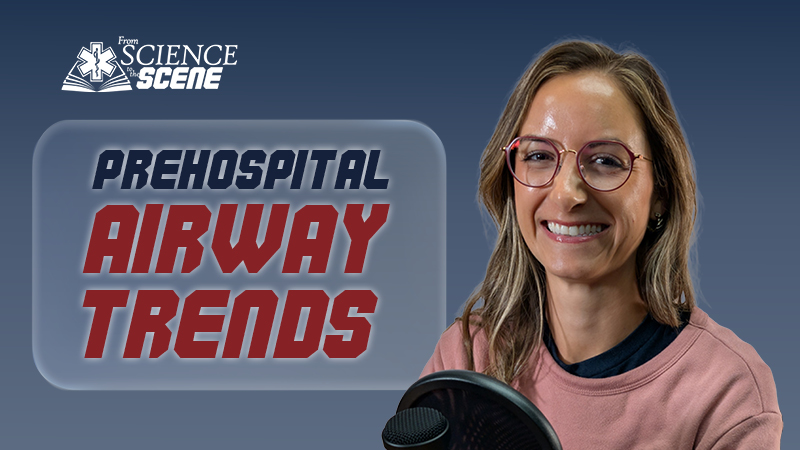
Prehospital Airway Trends
A national study published in Prehospital Emergency Care highlights new insights into prehospital trauma airway placement. Researchers evaluated over 5.7 million EMS trauma responses from the 2023 National EMS Information System dataset to understand how advanced airway device utilization varies across injury types.
While overall advanced airway placement is rare, occurring in less than four out of every 1,000 trauma activations, specific high-energy mechanisms demand rapid intervention. Falls and motor vehicle collisions account for the largest total volume of trauma calls, but firearm-related injuries and motorcycle crashes show the highest rates of advanced airway use across every age group. Firearm injuries resulted in over 51 advanced airway placements per 1,000 activations, and surgical cricothyrotomy was performed most frequently in cases involving firearm trauma and intentional self-harm.
Understanding these injury patterns allows EMS agencies to optimize training and equipment preparation. High-risk calls require early assessment and procedural readiness for complex airways.
Listen to the latest episode of From Science to the Scene for a deeper breakdown of this research!
Check out the full study here.
Watch on YouTube |
Listen on Buzzsprout |
More Episodes
Breaking the Silence: Mental Health Realities for EMS Clinicians
This episode examines state death records investigating suicide rates among prehospital personnel compared to the general public. The research reveals that EMS clinicians face 39% higher adjusted odds of death by suicide, with younger clinicians (ages 18–34) being exceptionally vulnerable, where suicide accounted for 23.5% of all deaths. These findings underscore the urgent need for active peer support and early mental health intervention.
Watch on YouTube | Listen on Buzzsprout |
Rethinking Seizure Management in the Field
Host Jacob breaks down a national study in Annals of Emergency Medicine revealing that guideline-concordant care (10 mg IM midazolam) occurred in only 4.1% of adult seizure encounters across 657 EMS agencies. The data proves intranasal (IN) administration had the highest first-dose failure rate, while higher doses improved seizure control without increasing respiratory depression.
Watch on YouTube | Listen on Buzzsprout |
Leveling Up Stroke Care: How Severity Scales Change Prehospital Practice
Host Kayla breaks down the latest consensus guidance on prehospital stroke care, focusing on stroke center designations and field severity scales. Clinicians will learn how to accurately match patient presentation to the correct receiving facility—differentiating between primary and comprehensive stroke centers—to eliminate delays and deliver time-sensitive interventions when every minute counts.
Watch on YouTube | Listen on Buzzsprout |
Prehospital Traumatic Brain Injury Treatment Guidelines
In this episode of From Science to the Scene, explore how standardized field guidelines are dramatically improving traumatic brain injury survival. Dr. Ash Panchal presents statistical evidence from the EPIC study showing that simple, rigorous interventions to eliminate oxygen drop, low blood pressure, and over-ventilation double overall survival and triple outcomes for intubated patients. Learn how EMS leaders can leverage this data to drive system-wide protocol updates.
Watch on YouTube | Listen on Buzzsprout |
Prehospital Airway Management
Host Chris Gage breaks down groundbreaking airway guidelines reshaping prehospital care. Discover why basic bag-valve-mask (BVM) ventilation remains the foundation of resuscitation, why supraglottic airways (SGAs) are often preferred over intubation, and why pediatric airways require extreme caution due to low procedural volume. Plus, learn how continuous waveform capnography and blood pressure management drive successful outcomes.
Watch on YouTube | Listen on Buzzsprout |
Shooting Victim Management
In this episode of From Science to the Scene, Dr. Ash Panchal examines critical research showing how civilian mass shooting casualties differ fundamentally from military combat injuries. With fewer than 1 in 4 victims surviving to reach a hospital, the data proves that traditional response plans must adapt. Discover why addressing internal chest trauma and minimizing on-scene times are vital to closing the narrow window for lifesaving intervention in chaotic environments.
Watch on YouTube | Listen on Buzzsprout |
Ketamine Use in Prehospital and Hospital Treatment of the Acute Trauma Patient
Research Fellow Jacob Kamholz unpacks the clinical versatility of ketamine as a prehospital powerhouse for pain management, sedation, airway induction, and acute agitation. This episode shatters historical myths by proving ketamine is safe for head and eye injuries without causing harmful pressure spikes. Learn the key safety steps, from weight-based pediatric dosing to strict airway monitoring.
Watch on YouTube | Listen on Buzzsprout |
Layperson-Administered Naloxone Trends
Research Fellow Jacob Kamholz shares a major study showing that layperson-administered naloxone (LAN) surged by over 43% in two years. Interestingly, while public interventions spiked—most frequently in urban homes where speed matters most—overall naloxone administration by EMS clinicians dropped 6%. Discover how national EMS data is proving the success of over-the-counter access and shaping public health policies.
Watch on YouTube | Listen on Buzzsprout |
Intra-arrest Transport vs Continued On-Scene Resuscitation
In this episode of From Science to the Scene, we examine the complexities of resuscitation during transport. Research indicates that moving a patient while their heart is not beating significantly degrades the quality of chest compressions and creates safety risks for the EMS crew. Kayla Riel explains how shifting the focus to on-scene stabilization can give patients a better chance at long-term recovery and returning to their families.
Watch on YouTube | Listen on Buzzsprout |
Tranexamic Acid During Prehospital Transport
Discover the nuances of the STAAMP trial and its implications for hemorrhagic shock. This episode explores why the "timing of care" is critical, as survival rates improved specifically for patients receiving TXA in the early stages of injury. By highlighting that there is no increased risk of adverse events, the research provides clinicians with the evidence needed to confidently integrate early TXA administration into their trauma protocols.
Watch on YouTube | Listen on Buzzsprout |
Pain Management
In this episode, National Registry Research Fellow Jacob Kamholz explores a national study on how pain is managed in the field. The research analyzed over 35,000 EMS records of adult patients with confirmed long bone fractures. By linking EMS data with hospital diagnoses, researchers were able to precisely identify the injuries treated by each Clinician.
Watch on YouTube | Listen on Buzzsprout |
Lights and Sirens
In this episode of From Science to the Scene, the National Registry Research Team dives into a massive study of over 19 million EMS calls. Host Chris Gage breaks down the math on whether "driving hot" actually helps or just hurts.
Watch on YouTube | Listen on Buzzsprout |
Challenges In EMS
In the debut episode, Research Director Ash Panchal and Research Fellow Chris Gage introduce a practical approach to turning complex medical literature into actionable patient care. They highlight key systematic reviews and break them down into concise, real-world insights to help EMS Clinicians apply the latest evidence in their day-to-day decisions.
Watch on YouTube | Listen on Buzzsprout |