
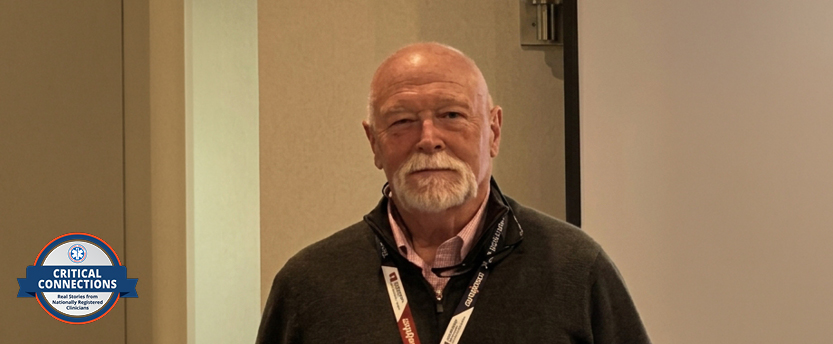
When Paul Biddle walked into a testing center in Bangor, Maine, on the afternoon of his 70th birthday, he carried more than months of studying, practice examinations, and preparation. He carried a lifetime of service.
By that point, Paul had already lived a life defined by curiosity, resilience, and a commitment to helping others. He had served in the British Army, built a career in law enforcement and intelligence, advised governments in conflict zones, trained military personnel and first responders around the world, and been appointed a Member of the Order of the British Empire (MBE) by Her Majesty, Queen Elizabeth II, for his public service.
His work had taken him across the globe, from Afghanistan and Iraq to Haiti, Ukraine, Palestine, Jamaica, Papua New Guinea, and beyond. Yet as he sat down to take the National Registry Emergency Medical Technicians (National Registry) certification examination, none of those accomplishments occupied his thoughts.
Instead, he was thinking about his father.
“My late father served as an Army medic in the jungles of Malaya,” Paul wrote in a LinkedIn post that first captured the attention of the National Registry. “Growing up, I always admired the quiet professionalism of those who could save lives under the most difficult conditions.”
For Paul, becoming an EMT at 70 was never simply about earning another credential. It was about honoring the person who first taught him what it meant to serve others.
Lessons From a Father Who Taught Through Stories
Long before Paul understood medicine, leadership, or service, he understood the power of a good story. His father rarely offered direct advice. Instead, he shared experiences from his own life and allowed the lessons to reveal themselves.
“He was always very much of the opinion that as a father, he should be telling stories based on his life,” Paul recalled. If Paul made a mistake, his father did not lecture him. He told him a story.
“If I touched an electric fence, he wouldn’t say, ‘Don’t touch the electric fence,’” Paul explained. “He would tell me the story about when he touched the electric fence.”
Every lesson came wrapped inside an experience, and his father had plenty of experiences to draw from. The son of a World War II veteran who was among the first wave to land on D-Day, Paul’s father served with the Royal Army Medical Corps and later worked as an Army medic during the Malayan Emergency, caring for wounded soldiers in one of the world’s most challenging environments.
Despite the dangers he faced, Paul’s father rarely focused on heroics. Instead, he focused on responsibility and taught his son that understanding the human body, knowing how to respond in an emergency, and being prepared to help others were skills everyone should have.
“He said, ‘You’ve got to learn how to fix yourself. If you don’t look after yourself, you’re not going to be able to help anyone else.’” Those words stayed with Paul and became the foundation for a lifetime spent preparing himself and others to respond when people needed help most.
A Life Built Around Service
At only 15 years old, Paul joined the British Army, beginning a journey that would span decades and take him around the world. Throughout his military and professional career, he specialized in intelligence, reconnaissance, security operations, emergency response, and training.
Whether supporting complex operations, strengthening emergency preparedness efforts, or teaching tactical medicine and lifesaving skills, Paul carried one principle with him throughout every chapter of his career. Knowledge is a responsibility.
His accomplishments earned many recognitions, including his appointment as a Member of the Order of the British Empire in 2002. However, Paul never viewed achievements as a place to stop. “I’ve never been one to rest on my laurels,” he said.
Even receiving the MBE was not a final destination. “It was wonderful for the family,” he said. “Then I put it in a box and thought, ‘What else can I do?’” That question has guided Paul throughout his life. Rather than looking back on what he had already accomplished, he continued finding ways to expand his skills, support others, and contribute wherever he was needed.
Starting Over
When Paul and his wife, Anne, moved to the United States in 2016, he faced a challenge he never expected. Despite decades of experience and a career built around service, many of his professional qualifications did not transfer.
For a brief moment, he was frustrated. “I was very angry for about fifteen minutes,” Paul admitted with a laugh. “Then I sat back and thought, ‘Do you know what? That’s not a bad thing.’” Instead of focusing on what he had lost, Paul focused on what he could build. “It allowed me to draw a line under my previous career,” he said. “I could start fresh without any baggage.”
So, he did. Paul earned new certifications, completed emergency management courses, volunteered with local emergency response organizations, and continued teaching preparedness and lifesaving skills throughout Maine.
Yet there was still one goal he had carried for years, one certification he had always wanted to earn, and that was to become a National Registry EMT. “I had always wanted to become an EMT,” Paul said. After decades as an instructor, he decided it was time to become a student again.
Becoming the Student
For much of his career, Paul had stood at the front of the classroom. Now, he was sitting in one. After years of teaching tactical medicine, emergency response, and lifesaving skills, he returned to the fundamentals, studying anatomy and physiology, patient assessment, trauma care, medical emergencies, and everything required to become an EMT.
The transition was humbling. Experience gave Paul a foundation, but it did not exempt him from the challenges of learning something new. “There were a few days when I thought, ‘I just can’t do this. It’s too much for me,’” Paul admitted. For the first time in years, he was not the instructor with the answers. He was a student working through unfamiliar material and facing the same challenges as his classmates.
Rather than discouraging him, the experience transformed the way he viewed teaching. “It made me a better teacher,” he said. Sitting on the other side of the classroom gave Paul a renewed appreciation for the patience, encouragement, and adaptability that effective instructors bring to every lesson. “I’ve always been critical of myself if people fail in anything that I’ve trained them in,” he said. “Trying not to fail people is an important aspect of instructing.”
Despite his decades of experience, Paul never wanted to be treated differently. When instructors or classmates turned to him and said, “Paul can tell us about that,” his response never changed. “Hey,” he would laugh. “I’m a student.”
That mindset became one of the most meaningful lessons of the journey. No matter how much experience he had accumulated, Paul understood there was always something new to learn.
Seventy Questions
Paul intentionally scheduled his National Registry certification examination for his 70th birthday. The timing was deliberate. “If I was going to fail, I wanted the best psychological thing for me, which was going to be my birthday,” he joked.
His wife expected to begin the day celebrating. Instead, she woke up to find Paul already studying. “Anne woke up in the morning to wish me a happy birthday, and I had already gone downstairs and was on the computer,” he said with a chuckle.
Later that afternoon, Paul arrived at the testing center ready to face the examination he had spent months preparing for. Question after question appeared on the screen, and then, after 70 questions, the examination ended. Paul knew the test stopping at that point could mean many things, but uncertainty took over. “I panicked,” he admitted.
He left the testing center and waited for his results. Another student from his class completed her examination after him and received her notification that she had passed before Paul received his own. He was happy for her, of course, but the wait became even harder as the minutes passed. “It was the worst ten minutes of my life,” he said. Then the notification appeared. He had passed.
For someone who had spent decades leading international operations, responding to crises, and receiving one of the United Kingdom’s highest honors for public service, this achievement carried a different kind of meaning. “National Registry certification is one of my biggest achievements,” Paul said. “There’s no question about that.”
This was never just about earning another certification. It was about proving that experience creates the foundation for what comes next.
Paul also knows he did not reach that moment alone. He expressed his sincere gratitude to Brooks Ambulance Service in Waldo County, Maine, and especially to the instructors who supported him throughout his training. Their patience, professionalism, encouragement, and exceptional teaching made a meaningful difference in helping him successfully pass his examination. Paul is deeply grateful for their dedication and support, as well as for Anne, who stood beside him and supported him throughout the entire adventure.
The Hand That Matters Most
After a lifetime spent around emergencies, Paul’s view of exceptional patient care is remarkably simple. “The greatest skill a medic has is holding somebody’s hand.” Not the equipment, the procedures, or the complexity of the situation. Just being present. “You don’t have to say anything,” he said. “Just being there and holding their hand.”
It is a lesson Paul continues to instill in the students he teaches and demonstrates through the way he carries himself. Drawing from a lifetime of experiences, he reminds others that emergency care is not only about knowing the right procedure or having the right skills, but about recognizing the person behind the emergency and being there when they need someone most.
Honoring His Father’s Legacy
After passing the examination, Paul’s thoughts immediately turned to the one person he wished he could call. His father. “I just got back that evening and thought, ‘I wish I could speak to Dad. Dad would be so pleased,’” Paul said.
When asked what his father would have said if he had been there, Paul did not hesitate. He knew his father would not have delivered a long speech or made a grand celebration out of the moment. Instead, Paul imagined his father offering the same quiet support he always had through a firm handshake, a smile, and likely an invitation to sit down over a beer and talk.
Paul saw that same understanding after returning home from his first deployment to Northern Ireland. He expected his father to ask about what he had experienced, but instead, his father opened the door and simply said, “Put your bag down there, son. We’re going down to the pub.”
Over a drink, his father gave him the space to share whatever he needed to say. “He never said, ‘What was it like?’” Paul recalled. “He just sat down and said, ‘Go on then, son, let it go.’” That was his father’s way of showing he cared. He did not need details or explanations. He simply made sure Paul knew he was home, he was safe, and he did not have to carry everything alone.
That quiet understanding has stayed with Paul throughout his life, shaping not only the way he teaches and leads, but also the way he cares for others.
A New Chapter of Service
For Paul, experience is not something to hold onto. It is something to share, pass forward, and use to help others grow. At 70 years old, Paul became a Nationally Registered EMT for the first time. Yet the significance of that achievement began many years earlier with a father who taught him through personal experience, instilled in him the importance of preparation, and showed him that helping others is a responsibility worth carrying throughout a lifetime.
That lesson has guided Paul through every chapter of his life, from the battlefield to the classroom, from teaching others to becoming a student again. Paul continues to carry forward the lessons his father shared throughout his life, including the understanding that learning has no retirement age.
For him, it is more than a mindset. It is a legacy passed down, a promise kept, and a way of life built on the conviction that there is always more to learn, more to do, and more opportunities to apply what he has learned along the journey.
About the National Registry of Emergency Medical Technicians
Guided by our mission to support the EMS profession through partnerships, research, and lifelong assessment of clinical competence, the National Registry was established in 1970 as a non-profit organization and serves as the Nation’s Emergency Medical Services certification organization. It is accredited by the National Commission for Certifying Agencies (NCCA), the accreditation body of the Institute for Credentialing Excellence. The National Registry maintains NCCA accreditation for each of the four certification programs: Emergency Medical Responder (NREMR), Emergency Medical Technician (NREMT), Advanced Emergency Medical Technician (NRAEMT), and Paramedic (NRP). Credentialing protects the public, assures consumers that Clinicians have met standards of practice, advances the EMS profession, and establishes standards of professional knowledge, skills, and practice. Additional information is available at NREMT.org, and BlueSky, TikTok, Facebook, Instagram, LinkedIn, Reddit, and YouTube.
Media Contact:
Kelly Schroeder
Manager of Integrated Content & Communications
kschroeder@nremt.org