

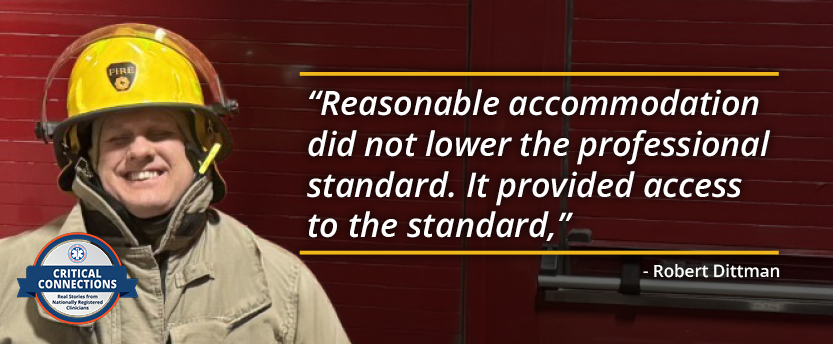
Robert Dittman has built a life around service, from a career in law to his work as a volunteer firefighter and public safety leader. Completely blind since early childhood, he has spent his life finding ways to pursue his interests, develop his skills, and contribute to his community. Yet even after years of challenging expectations, he once questioned whether a path into emergency medical services (EMS) was realistic.
Today, Dittman serves as an assistant chief and legal officer with Sparta Fire Rescue in Texas and is a National Registry Emergency Medical Technician (EMT) and Texas-certified EMT, authorized to practice within his scope under appropriate medical direction. His certification journey began with becoming a Nationally Registered Emergency Medical Responder (EMR), an accomplishment that opened the door to further training and a greater role in emergency response. Looking back on his initial hesitation about entering EMS, Dittman offered a candid reflection. “I don't even know why I put the self-imposed wall up,” he said with a laugh. It was a field he had never considered for himself, despite a lifetime of finding ways to serve his community and take on new challenges.
Born with retinopathy of prematurity, Dittman grew up with parents who encouraged him to explore his interests and pursue opportunities on his own terms. He became an Eagle Scout, joined the Civil Air Patrol, served in the U.S. Coast Guard Auxiliary, and built a career in law. Public service was already an important part of his life, but emergency medicine presented a different kind of challenge, one that required him to reconsider what he thought he could do.
He was introduced to EMS through his professional responsibilities, which brought him into contact with emergency medical training. After completing his EMR education, Dittman began applying what he had learned in real-world situations. During one early emergency response, he helped relay critical information to dispatch while other responders treated a patient, and he and his partner later received lifesaving medals for their actions.
The experience showed Dittman how his training could translate into meaningful contributions during an emergency. Patient care requires clinical knowledge, clear communication, sound judgment, and the ability to recognize what needs to happen next. It also depends on teamwork, with each Clinician contributing individual skills and experience to help the crew provide effective care.
As Dittman's interest in EMS grew, so did his desire to take on greater responsibility. He joined Sparta Fire Rescue and began working toward EMT certification. Along the way, he learned new skills, adapted to the demands of emergency response, and navigated a certification process that provided access to the examination while maintaining the professional standards required of every Candidate. He ultimately passed the National Registry EMT certification examination, reaching a milestone he once questioned whether he could achieve.
Access to the Same Standard
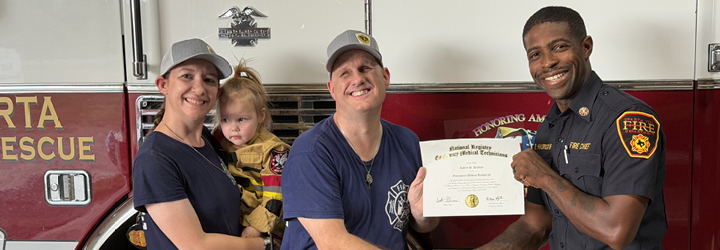
Preparing for the National Registry EMT certification examination required Dittman to approach some parts of the process differently, but the rigorous standard remained the same. With accommodations coordinated through National Registry accommodations specialist Amber Fuller, he received additional time and had examination questions read aloud, allowing him to access the same content other Candidates were required to master.
“Reasonable accommodation did not lower the professional standard. It provided access to the standard,” Dittman said. Accommodations did not replace the hours of learning, the effort required to prepare, or the need to demonstrate competence. They provided a way for him to show what he knew without allowing the format of the examination to become a barrier unrelated to his knowledge and skills.
Dittman speaks appreciatively about the support he received throughout the process. He credited Fuller with helping coordinate his accommodations and making sure he had what he needed to access the examination. Her support allowed him to focus on demonstrating what he had learned and his readiness to serve as an EMT.
Passing the EMT certification examination was a moment of tremendous pride. Dittman had worked toward a goal that once seemed outside the scope of his life, and he had achieved it while meeting the same professional standards required of every Candidate. The accomplishment reflected his persistence and the importance of having an opportunity to pursue a path on his own terms.
For Dittman, earning the certification was not simply the completion of a process. It marked the beginning of a greater role in a profession where he could continue serving others alongside the people who had become his colleagues and fellow Clinicians.
Earning a Place on the Crew
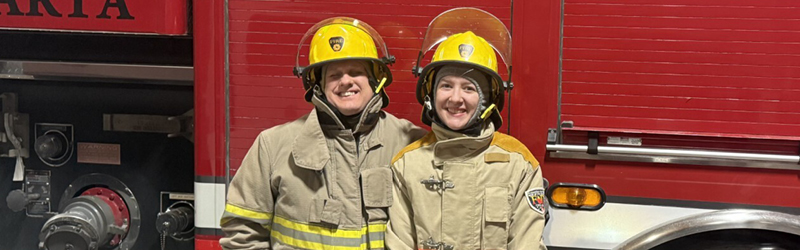
At Sparta Fire Rescue, Dittman has found opportunities to put his training into practice alongside fellow firefighters and EMS Clinicians. He and his wife, Kirstiana, who is also a volunteer firefighter and Nationally Registered EMR, travel approximately 75 to 85 miles from their home in San Marcos to Bell County about once a month to fulfill their reserve duties.
Dittman approaches emergency response with preparation, accessible equipment, and a practical understanding of how to work effectively with his crew. He uses a talking blood pressure cuff, pulse oximeter, thermometer, and glucometer, and organizes his supplies so he can locate what he needs. He also uses his stethoscope to assess patients and records information on his phone. When an assessment requires visual information he cannot independently obtain, such as evaluating a patient's pupils, he asks a fellow Clinician to assist.
His responsibilities extend beyond assisting with individual assessments. Dittman has responded to medical calls as the only EMT on his crew, conducting patient assessments, obtaining vital signs with accessible equipment, and helping direct patient care within his scope of practice. He also assists with firefighter rehabilitation, triage, scene safety, and accountability as appropriate. These responsibilities reflect the practical ways he contributes to patient care and fireground operations while working within established protocols and alongside his fellow Clinicians.
These adaptations reflect how Dittman approaches his responsibilities. He knows which skills he can use independently, recognizes when another Clinician's assistance is needed, and understands the importance of communicating clearly throughout an assessment. He also brings a sense of humor to the way he explains his approach. When describing how a sighted colleague can help with the visual component of an assessment, Dittman put it this way. “If I, as a blind person, can explain, then really the sighted person becomes just another diagnostic tool.”
Behind the humor is a practical understanding of how EMS works. Emergency response is collaborative by nature, and effective patient care depends on knowing how to communicate, recognize when help is needed, and work together toward a common goal.
For Chief Robert Hadrick, welcoming Dittman to the department also meant thinking carefully about how to build a crew in which every member could contribute safely and effectively. Hadrick had never led a blind firefighter before and initially had questions about how Dittman would perform the work. Emergency response demands preparation, sound judgment, and trust among crew members, and Hadrick wanted to ensure those expectations were met.
Rather than assume he already knew what Dittman could or could not do, Hadrick began reconsidering the questions he needed to ask. “I had to move beyond my initial question of ‘What can a blind man do on a fire department?’ and start asking the questions I should ask about every member,” Hadrick said. “What are this person's strengths? What training do they need? What responsibilities can they carry? How do we help them succeed while maintaining our standards?”
Hadrick said Dittman showed up ready to listen, train, ask questions, and learn. He took his responsibilities seriously, worked to improve, and earned the trust of the people around him. “Rob did not ask me to lower my expectations. He gave me reason to examine my assumptions,” Hadrick said.
That trust has developed through the everyday work of serving together. Firefighter Adrian Moreno, who has responded to medical calls alongside Dittman, described how he provides guidance when needed so Dittman can reach a patient and assist with care. “What stands out to me is his discipline and his faithfulness to the service,” Moreno said. “He shows up for medical calls ready to help.”
Fellow firefighter Roddrick Crowell has also found a mentor in Dittman. Crowell credits Dittman's instruction and encouragement with helping him become a better firefighter, describing their relationship as one built on friendship, mutual respect, and a shared commitment to the work.
Their experiences offer a fuller picture of Dittman's place in the department. He is not simply someone who has found a way to participate in a field he once questioned entering. He is a colleague who contributes his knowledge, helps others develop their skills, and continues learning alongside the people he serves with.
Looking Beyond Assumptions
Dittman's path into EMS has not been without difficult moments. Along the way, he has met people who questioned whether a blind person could safely perform EMS duties. One paramedic instructor told him that blindness was incompatible with patient care and teaching. The encounter was hurtful, but it also exposed a misconception that can prevent people from pursuing opportunities before they have a chance to demonstrate what they can do.
Dittman does not suggest that every person can perform every role or that safety requirements should be overlooked. He believes decisions about an individual's ability to serve should be based on that person's training, skills, responsibilities, and capacity to perform the work safely, rather than assumptions made solely on the basis of disability.
His own experience illustrates the importance of that distinction. He has had to learn, adapt, communicate, and demonstrate his competence, just as he has had to recognize when collaboration is necessary. He has also benefited from people who were willing to consider his individual strengths and give him a fair opportunity to succeed.
That willingness to look beyond assumptions has implications beyond the firehouse. It can determine whether someone feels encouraged to pursue a career, whether a qualified Candidate has a meaningful opportunity to demonstrate their knowledge, or whether a potential colleague is given the chance to contribute to a team.
For Dittman, the lessons of EMS also reach into his life at home. As a husband and father to a young daughter, he values the knowledge he and Kirstiana have gained through their training and the confidence it gives them to better understand health concerns and respond calmly when their daughter needs care. He also believes parents should have a basic understanding of emergency medical care.
“I think it is important for parents to have at least a basic understanding of emergency medical care. You never know when something could happen with your child, and having that knowledge can help you recognize when something is wrong and know what to do. Becoming a father has made that knowledge even more important to me. It is one thing to use these skills when responding to a call, but it means something different when it is your own child.”
The skills he has worked to develop extend beyond emergency calls. They are another way he can care for his family and serve the people around him.
A Message to Others
Dittman hopes sharing his story will encourage others who have questioned whether they belong in EMS to take a closer look at what might be possible. He knows the uncertainty that can come with navigating training, understanding available accommodations, and wondering whether others will recognize your potential. But he does not want that uncertainty to keep someone from taking the first step.
“If this story can get another Candidate to not have to deal with the fear of ‘I don't know what to do, so I'm not going to do anything,’” he said, “then we've accomplished something great.”
His own path from EMR to EMT is proof of what can happen when someone challenges a long-held belief and pursues an opportunity once thought unattainable. By sharing his experience, he wants others to recognize that they, too, have a place in EMS, while reminding the people and organizations around them to look beyond assumptions and recognize the contributions people can make when given a fair opportunity. Sometimes, all it takes to change someone's sense of what is possible is for another person to believe in them enough to offer that chance.
About the National Registry of Emergency Medical Technicians
Guided by our mission to support the EMS profession through partnerships, research, and lifelong assessment of clinical competence, the National Registry was established in 1970 as a non-profit organization and serves as the Nation’s Emergency Medical Services certification organization. It is accredited by the National Commission for Certifying Agencies (NCCA), the accreditation body of the Institute for Credentialing Excellence. The National Registry maintains NCCA accreditation for each of the four certification programs: Emergency Medical Responder (NREMR), Emergency Medical Technician (NREMT), Advanced Emergency Medical Technician (NRAEMT), and Paramedic (NRP). Credentialing protects the public, assures consumers that Clinicians have met standards of practice, advances the EMS profession, and establishes standards of professional knowledge, skills, and practice. Additional information is available at NREMT.org, and BlueSky, TikTok, Facebook, Instagram, LinkedIn, Reddit, and YouTube.
Media Contact:
Kelly Schroeder
Manager of Integrated Content & Communications
kschroeder@nremt.org