
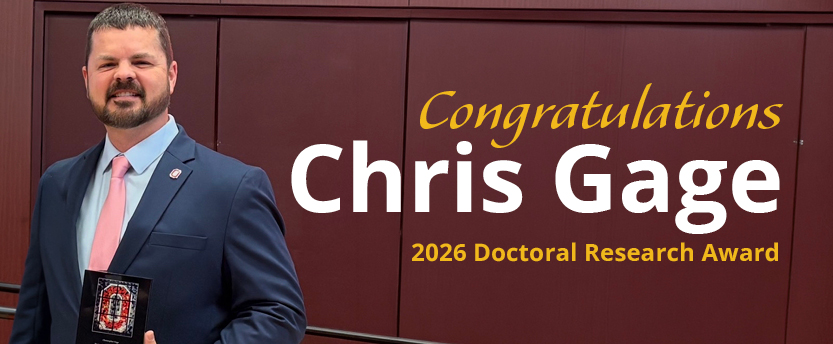
The Doctoral Research Award is part of a newly established set of honors introduced this year by The Ohio State University College of Public Health and recognizes exceptional doctoral research and scholarship. Chris is the first recipient to be recognized for this award, highlighting the impact of his contributions to EMS research and public health.
“Chris brings intellectual rigor, relentless curiosity, and a true commitment to improving public health. His ability to translate EMS frontline experience into high-impact research using EMS data makes this recognition well deserved,” said Dr. Ashish Panchal, director of research at the National Registry.
The news of the award came as a surprise. While preparing for a pre-commencement ceremony, his advisor called and instructed him and his wife to arrive early and sit in the front row. “I technically did not know until I showed up, and they called my name,” Chris said. “That was really the moment it became real.”
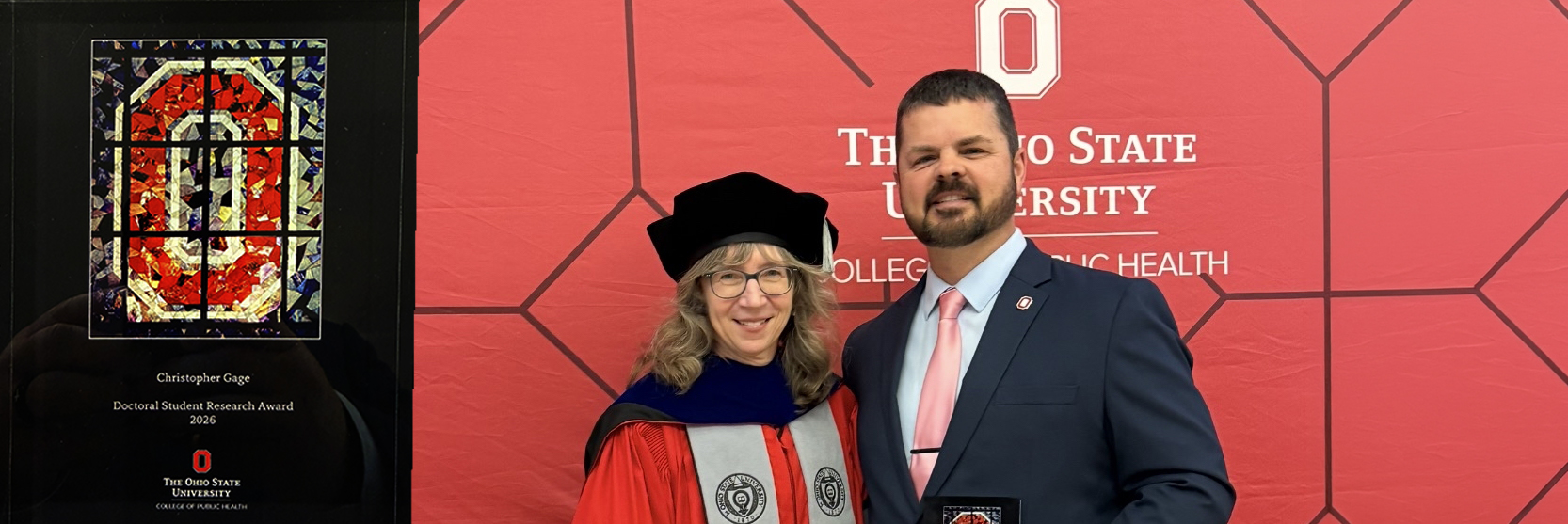
Chris Gage appears alongside his doctoral advisor, Amy Ferketich, PhD, after receiving the Doctoral Research Award from The Ohio State University College of Public Health
The award recognizes a growing body of research that has helped advance understanding of critical issues facing emergency medical services. Among Chris’s most notable research is his work examining layperson naloxone administration and its role in responding to opioid overdoses published in JAMA. Using data from the National EMS Information System, Chris and his collaborators analyzed tens of millions of EMS patient care records and identified a 43 percent increase in layperson-administered naloxone between 2020 and 2022, along with a corresponding decrease in EMS-administered naloxone during the same period.
The findings highlight the growing role of community members in initiating early overdose responses and reflect broader national efforts to expand access to naloxone through public health initiatives and community distribution programs.
“By leveraging national EMS data, Chris has produced important insights on naloxone use and overdose outcomes,” Panchal said. “This work helps us better understand the impact of community overdose response efforts and the evolving role of layperson intervention.”
While the naloxone study is one example of Chris’s impact, it represents only a portion of his growing body of research. Since joining the National Registry’s EMS Research Fellowship, Chris has expanded his research portfolio from one published manuscript prior to entering the program to nearly 50 publications. His work has focused on using large-scale EMS data systems to better understand prehospital care, identify emerging trends, and generate evidence to improve patient care and system performance.
Chris emphasized that the recognition reflects the efforts of a much larger team. “Ashish Panchal, Michael Lyons, Rebecca Cash, and so many others are powerhouses in this field,” Chris said. “I may be the one receiving the award, but it reflects the strength of our team and the opportunities that the fellowship provides.”
He also credited mentors and collaborators at The Ohio State University, Harvard University, and across national EMS research networks for supporting his academic and professional development. “From EMT to doctoral-trained researcher, it has been an incredible journey,” Chris said. “The fellowship has opened doors to opportunities I never imagined.”
Chris is currently preparing for his dissertation defense, scheduled for July 2026. His doctoral research focuses on EMS workforce health, specifically tobacco and nicotine use among EMS Clinicians and the role of agency-level workplace policies. His work examines patterns of use, organizational policy environments, and how policy communication and enforcement may influence tobacco-related norms within EMS agencies.
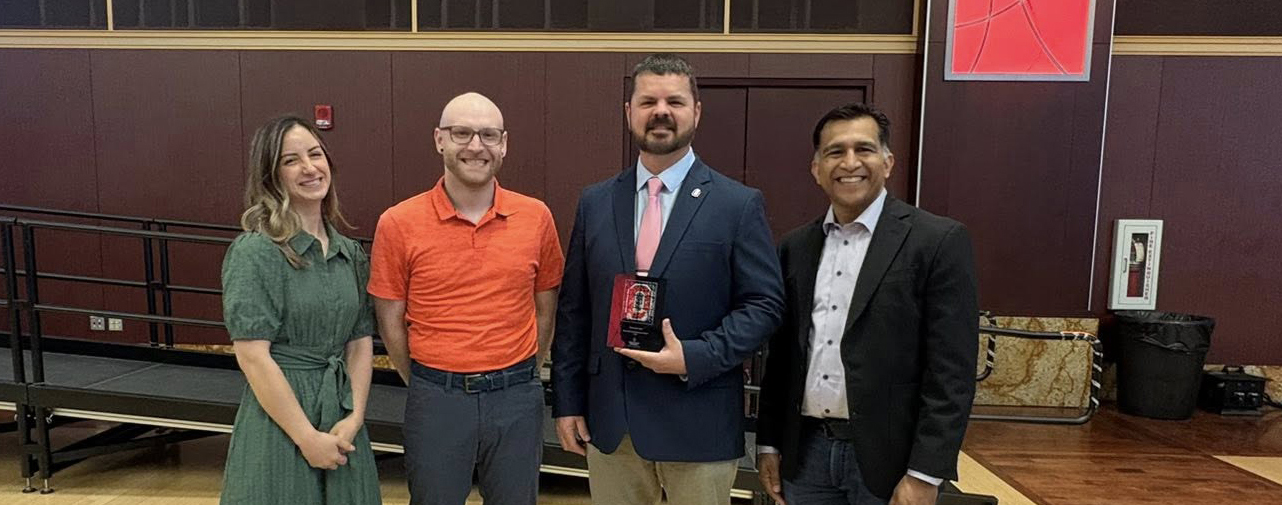
From left, National Registry Research Fellows Kayla Riel, Jacob Kamholz, and Chris Gage, holding the Doctoral Research Award, stand with Dr. Ash Panchal, Research Director at the National Registry.
While the award recognizes Chris’s individual achievements, his success also reflects the opportunities provided through the National Registry EMS Research Fellowship. The fellowship was established to develop experienced EMS Clinicians into future leaders in research, data science, and public health by supporting doctoral education and hands-on research experience.
Through the fellowship, participants are employed by the National Registry while pursuing a Ph.D. at The Ohio State University College of Public Health. Fellows receive full tuition and fee support, competitive salary and benefits, mentorship from national EMS and research leaders, and opportunities to conduct applied EMS research using some of the largest EMS datasets in the country.
The National Registry created the fellowship to strengthen research capacity within EMS and provide Clinicians with a pathway to advanced education and careers in research. Chris’s accomplishments demonstrate the impact such opportunities can have on both individual researchers and the profession as a whole.
Recruitment for the next EMS Research Fellow is scheduled to open in August 2026, with the fellowship beginning in June 2027. Candidates typically hold a master’s degree in public health, epidemiology, statistics, or a related field, along with EMS certification at the EMT level or higher and a strong interest in research and data analysis.
Chris encourages EMS Clinicians interested in research to seek mentorship opportunities, including the National Registry Summer EMS Research Mentorship Program, and explore programs that provide exposure to research methods and collaboration.
He also emphasized the importance of accurate EMS documentation, which serves as the foundation for research that helps improve patient care and system performance. “People like me are using that data to understand trends and develop solutions,” Chris said. “If it is not accurate, we cannot draw accurate conclusions.”
The National Registry congratulates Chris Gage on this outstanding achievement and well-deserved recognition of his contributions to EMS research, public health, and the future of the EMS profession.
About the National Registry of Emergency Medical Technicians
Guided by our mission to support the EMS profession through partnerships, research, and lifelong assessment of clinical competence, the National Registry was established in 1970 as a non-profit organization and serves as the Nation’s Emergency Medical Services certification organization. It is accredited by the National Commission for Certifying Agencies (NCCA), the accreditation body of the Institute for Credentialing Excellence. The National Registry maintains NCCA accreditation for each of the four certification programs: Emergency Medical Responder (NREMR), Emergency Medical Technician (NREMT), Advanced Emergency Medical Technician (NRAEMT), and Paramedic (NRP). Credentialing protects the public, assures consumers that Clinicians have met standards of practice, advances the EMS profession, and establishes standards of professional knowledge, skills, and practice. Additional information is available at NREMT.org, and BlueSky, TikTok, Facebook, Instagram, LinkedIn, Reddit, and YouTube.
Media Contact:
Kelly Schroeder
Manager of Integrated Content & Communications
kschroeder@nremt.org