
Collaborative study aims to clarify how occupational exposures, injuries and stress shape health over time.
COLUMBUS, OH — September 14 — The National Registry of Emergency Medical Technicians today announced the launch of the website for the LIFE Study, the Longitudinal Inquiry into Fire and EMS Health Study, a collaborative research effort designed to better understand the cumulative health risks firefighters and EMS Clinicians face throughout their careers.
Firefighters and EMS Clinicians routinely encounter harmful substances, job-related injuries, workplace violence, and significant physical and psychological stress. These risks may contribute to cardiovascular disease, cancer, and mental health disorders, but their combined effects over time remain poorly understood. Although individual occupational risks have been studied, no large-scale effort has evaluated these combined risks longitudinally in this population.
The LIFE Study will follow firefighters and EMS Clinicians over time and gather information about occupational exposures and health outcomes. By identifying how risks accumulate and intersect, the research aims to generate evidence that can inform future policies, safety practices, health interventions, and additional research.
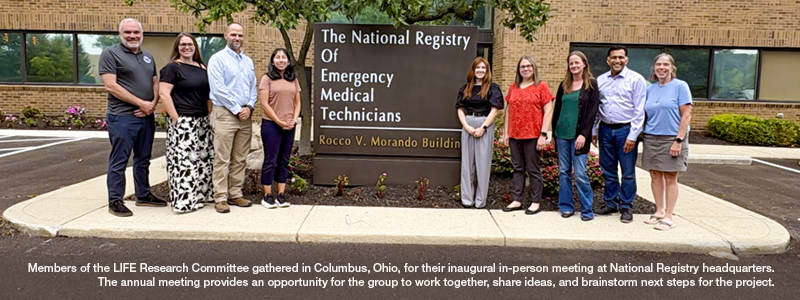
“Firefighters and EMS Clinicians dedicate their careers to protecting others, yet we still do not fully understand how the exposures, injuries, and stress they experience accumulate over time,” said Ashish Panchal, MD, PhD, lead primary investigator for the LIFE Study, professor of emergency medicine at The Ohio State University and research director at the National Registry of EMTs. “The LIFE Study brings together experts and organizations from across fire, EMS, and occupational health to build the long-term evidence needed to better protect the people who protect our communities.”
Led by the National Registry of Emergency Medical Technicians, the LIFE Study brings together the Emergency Medicine Network (EMNet), The Ohio State University College of Medicine, National Development and Research Institutes, Inc. (NDRI USA), the University of Arizona, and Uniformed Services University/NIDHC. The multidisciplinary investigator team includes experts in emergency medicine, fire and EMS health, public health, psychiatry, epidemiology, occupational health, and research operations.
The new website explains the need for the study, its longitudinal approach, the participating organizations, and the research and advisory teams. It also includes frequently asked questions, study news, and an email sign-up for future updates. While the study is not currently recruiting research participants or investigators, you can sign up for email updates, which will include opportunities for participation.
To learn more about the LIFE Study and sign up for updates, click the link below.
Visit the LIFE Study Website
About the LIFE Study
The LIFE Study, or Longitudinal Inquiry into Fire and EMS Health Study, is a collaborative research effort designed to better understand the long-term health effects of occupational exposures, injuries, and stress among firefighters and EMS Clinicians. By following these first responders over time, LIFE aims to build evidence that can guide future policies, interventions, and research to improve first responder health and safety.
Learn More
About the National Registry of Emergency Medical Technicians
Guided by our mission to support the EMS profession through partnerships, research, and lifelong assessment of clinical competence, the National Registry was established in 1970 as a non-profit organization and serves as the Nation’s Emergency Medical Services certification organization. It is accredited by the National Commission for Certifying Agencies (NCCA), the accreditation body of the Institute for Credentialing Excellence. The National Registry maintains NCCA accreditation for each of the four certification programs: Emergency Medical Responder (NREMR), Emergency Medical Technician (NREMT), Advanced Emergency Medical Technician (NRAEMT), and Paramedic (NRP). Credentialing protects the public, assures consumers that Clinicians have met standards of practice, advances the EMS profession, and establishes standards of professional knowledge, skills, and practice. Additional information is available at NREMT.org, and BlueSky, TikTok, Facebook, Instagram, LinkedIn, Reddit, and YouTube.
Media Contact:
Kelly Schroeder
Manager of Integrated Content & Communications
kschroeder@nremt.org