
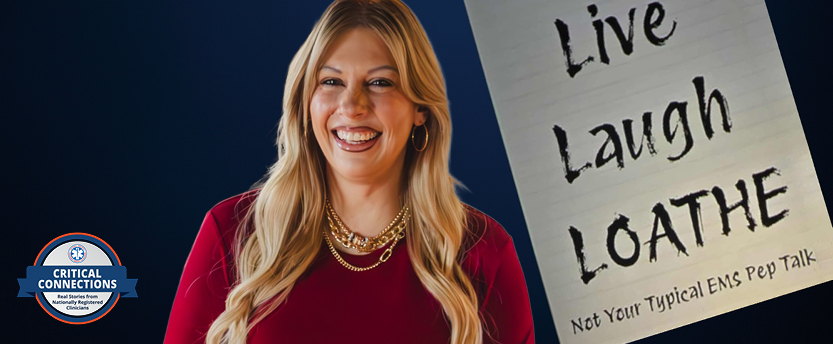
There are moments in a person’s life that last far beyond the moment itself, and for Liz Harney, one of those moments happened when she was at her lowest. She had relapsed after a year of sobriety and had spent so long in a contorted position that she developed rhabdomyolysis and could no longer walk. Her kidneys were failing. She was defensive, ashamed, and overwhelmed, surrounded by EMS Clinicians urging her onto a stretcher, unable to understand that she physically could not move.
Through the chaos, one Paramedic approached her and knelt down beside her. “She just stopped what she was doing and looked at me.” The Paramedic took Liz’s hands and looked directly into her eyes. “There’s still life behind those eyes. You can do this. You’re going to be able to get through this.”
Liz remembers something else about that moment. She believed her. “When you’re at that level, you can kind of sense it,” Liz said. “You can sense someone being so truly authentic in their words and what they’re saying to you. They’re really, truly talking to you.”
For a woman who had spent years being defined by her addiction, her mistakes, and the worst moments of her life, someone had finally looked past all of it. She saw a human being, and Liz never forgot it.
She Didn’t Just Get Sober, Liz Started Living
Today, Liz is a Board-Certified Critical Care Paramedic and Community Paramedic, Educator, former Program Director, advocate, national speaker, published author, and co-founder of Paramedic Pathways, a nonprofit supporting future Paramedics through scholarships. She is one class away from a master’s degree in business, recently added another board certification, and is even considering a doctorate.
Degrees and certifications hang on the wall behind her, but another accomplishment means something different. “I had this idea the other day,” Liz shared. “I just had this idea of showcasing all of these hard-earned degrees, and then my one-day chip of being sober. I wouldn’t have any of that if it wasn’t for this.”
Perhaps that is the simplest way to understand Liz. She did not get sober merely to survive. She got sober and chose life, a life she had to rebuild one day at a time. “I just haven’t stopped going,” she said with a laugh. At first, that meant living in a car, then moving into her mother’s basement, working an $11-an-hour job an hour away, attending four or five recovery meetings a week, and staying close to her sponsor. Little by little, she was learning how to build a life that could hold her sobriety.
Sometimes, she explained, it was not even one day at a time. “It was like one hour, one second sometimes.” At that point, survival was the goal. She had no idea that something was waiting around the corner that would give her a reason to dream about what came next.
Finding Something to Live For
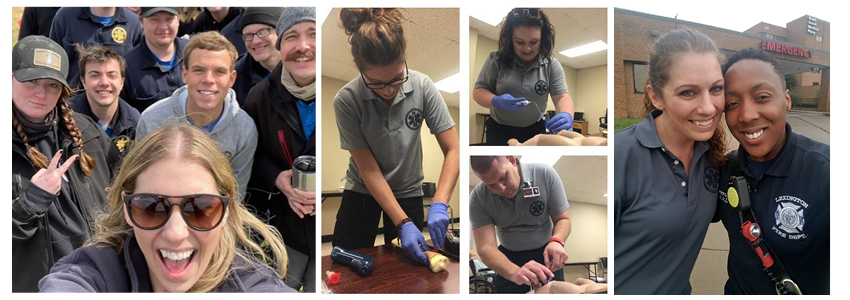
Only a few weeks into sobriety, Liz saw a woman at church wearing a shirt that said “Paramedic,” and remembers looking at her and thinking, I want to do that. The thought stayed with her, but then came the questions. Could she do this? Was she legally able to become a Paramedic with her past? What would it take?
She didn't wait for all the answers. Four months into sobriety, Liz started EMT school, and when she finished, she went straight into Paramedic education. “I had to have a goal,” she said. That goal eventually led her into a career that, as she describes it, “completely reignited the passion in me as a human being.”
Getting there was not easy. Some agencies would not hire her because of her past, and she worried about what people would think if they learned her history and saw what might show up on her background checks. She had worked so hard to build a new life, yet parts of her old one were still following her.
Eventually, one service took a chance on her, and years later, Liz learned just how much of a chance they had taken. Before hiring her, the service had contacted the Kentucky Board to determine whether they could legally do so. They knew her history, and they knew what might appear on a background check. They simply never told her.
They gave her a chance, and Liz made the most of it. That experience became part of what she carried with her into every patient encounter that followed. She knew what it felt like to be judged by your past, but she also knew what it could mean when someone chose to see what was still possible.
The Full-Circle Call
It was not until her first overdose call that everything came full circle. The patient was a young woman whose children were in the back of the house, terrified and screaming while their mother lay unconscious. Liz's partner was a veteran Paramedic, clinically excellent but, as Liz described him with a laugh, “grumpy.” It was a difficult scene.
When the patient woke up, she was distraught, and she told Liz she had just relapsed after a year of sobriety. Liz did what she needed to do clinically, but she also saw something beyond the call. She saw herself. She knew what it was like to have a year of sobriety behind you and suddenly find yourself back in that place. So, she hugged her.
On the ride to the emergency department, the woman worried about her children and what would happen next. Liz reassured her that there would be steps to take, and that it would be hard, but she could do it. Then, quietly, Liz shared something of her own. She had been there, too. “I had, like, X number of years sober at the time,” Liz recalled. “And she just looked at me like, ‘You did?’”
For Liz, the moment felt like a full circle. Years earlier, someone had looked at her when she was at her lowest and offered her something she desperately needed, hope. Now, Liz was sitting beside someone in that same place, offering it back.
Then the moment changed. At the hospital, a nurse arrived with paperwork for the patient to leave against medical advice and immediately told her that Child Protective Services had already been called. Liz watched the woman go from calm and willing to face what came next to completely overwhelmed. The compassion she had felt on the ride to the hospital seemed to disappear the moment they walked through the doors. The focus shifted to consequences, while the person at the center of it all seemed to disappear.
Liz couldn't stop thinking about it. Soon, she began noticing the same thing everywhere. Patients struggling with addiction were being treated as though they did not matter, reduced to their diagnosis, their behavior, or the number of times they had called 911. She recognized it because she had lived it. “I was watching patients being treated like they didn’t matter, just like I had been treated like I did not matter for a long time,” Liz says.
Eventually, she could no longer stay quiet. She describes it as an “explosion moment.” People around her could see that she was angry, but they did not understand why. Then, Liz told them the truth. Her truth.
You Can't Teach Someone to Care, But You Can Show Them What It Looks Like
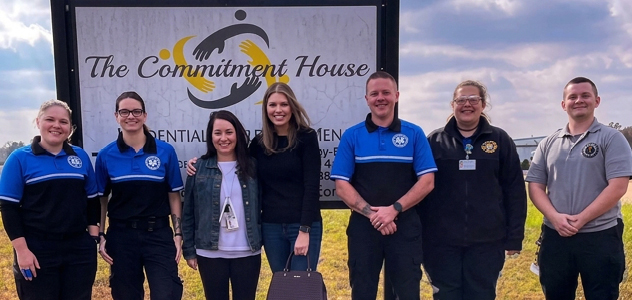
Liz now carries that experience into her work as an educator, but she learned quickly that empathy cannot simply be assigned as a classroom expectation. “You can’t stand in front of the classroom and just be like, ‘You all need to be nicer,’” she laughed. “That’s not gonna go.” So instead, Liz gave her students an opportunity to understand why it matters.
She began bringing them into the “trenches” at an inpatient rehabilitation center. Before each visit, she would share her own story with the people in recovery, explain why she had asked her students to come, and tell them what she hoped they would take away from the experience.
Then she brought the students in, where they sat with people from all walks of life who were fighting their way through recovery. They listened to stories that were deeply personal, painful, and raw. Some students sat one-on-one with people whose lives could have easily been reduced to a diagnosis, a chief complaint, or a label in a patient care report.
Instead, they heard the person behind the story. “There was never a dry eye in the house,” Liz said, and something began to change. Not for everyone, and not all at once, but many students left with a different understanding of the people they would eventually care for. They carried that perspective back into the classroom, into simulations, and eventually, into the EMS services where they worked.
“That’s when you know, like, as a Program Director, that you’re effectively preparing these folks to go out there and see people for who they really are,” she says. “Not just the addiction. Not just the worst moment.” Some became advocates in their own agencies, while others asked their leaders to bring people in recovery into their services so their colleagues could hear those stories, too.
Liz may never know how many patients were treated differently because one of those students once sat in a rehabilitation center and listened, how many Clinicians saw someone differently, or how many patients felt, even for a moment, that the person standing over them actually saw them.
“You can’t even ascertain as to how many people are going to be truly affected by one little...” she says, trailing off before finishing the thought with a smile. One story can change the way someone sees a patient, and that changed perspective can follow a Clinician back to an agency, into a classroom, or onto the next call.
We Never Get to See the Hope
Liz believes one reason EMS struggles to see people with addiction as whole human beings is that Clinicians rarely get to see what comes after the worst moment. “They only ever see an overdose,” she says. “We only ever see the screaming kids. We only ever see the devastation and destruction that it brings.”
What they often do not see is what comes next, the recovery, the families reunited, the homes regained, the careers rebuilt, and the lives slowly put back together. “We never get to see the hope,” Liz said quietly. She wants to change that. “Show your people the hope. Bring in people in recovery.”
Liz encourages EMS leaders to let people in recovery tell their stories and let Clinicians see what is possible on the other side of addiction. Sometimes the most powerful intervention is not a statistic, a protocol, or a clinical skill. Sometimes it is sitting across from someone who has lived through addiction and seeing, firsthand, that recovery is possible. “People underestimate the power of storytelling,” Liz says. She knows because she has lived it.
That belief is also part of why Liz is so passionate about community paramedicine. To her, it represents a different way of practicing EMS, one that moves beyond simply transporting a patient, and instead takes the time to understand the person behind the call. “It truly is human,” she said with a smile.
Community paramedicine gives Clinicians the opportunity to build relationships with patients, understand the circumstances affecting their health, and connect them with resources such as food, transportation, housing, insurance, and rehabilitation. Instead of simply arriving during a crisis, Clinicians can listen, follow up, and help patients take a more active role in managing their health, creating opportunities to meet people outside of their worst moment. “It’s improving the perspective that those highly stigmatized patient populations have toward entities like EMS or fire,” Liz says. “It’s a beautiful thing.”
Presence Is an Intervention
Ask Liz what happens when clinical skills grow faster than humanity, and her answer is immediate. “You can do everything clinically right, and you can still cause harm.” For Liz, being present with a patient is not something separate from clinical care, it is part of the care itself.
“People have to understand that their presence is an intervention,” she says. “They’re not going to remember what you did,” Liz says. “They’re not going to remember what medication you drew up, but they are going to remember how you made them feel.” That interaction may have an impact far beyond what a Clinician can see. “Some will never tell you, some are never going to come back, and some are going to change because of you, and you will never know.”
Every patient encounter is an opportunity to remind someone, perhaps at a moment when they have forgotten it themselves, that they are still a person worthy of being seen, heard, and cared for.
There Is a Way
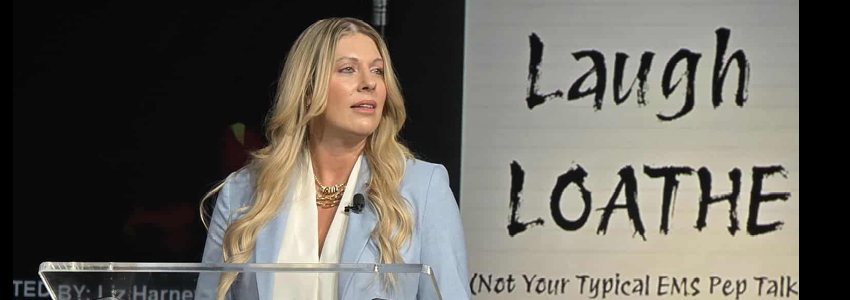
Liz describes herself as a dreamer, but her optimism is not rooted in naiveté. It comes from knowing what it feels like to be told there is no hope and then spending the next decade proving that hopelessness is not the same thing as an ending.
She still remembers a doctor telling her mother that she had a better chance of becoming a brain surgeon than of overcoming a heroin addiction. Those words could have defined who she was, but instead, they became something she carried with her as she built a life the doctor had never imagined for her. “When you are discarded as somebody that there’s no hope for, and then you’re able to come on the other side of that and not just stay at a level, but continue to pursue and succeed,” she says, “you feel like there is literally nothing else in the world you cannot do.”
Liz knows how easily someone can be reduced to the worst thing they have done, the hardest thing they have faced, or the moment when everyone around them has stopped believing they can change. She also knows what can happen when even one person refuses to see them that way. Her optimism is not about pretending the road will be easy, it is about knowing that a difficult road can still lead somewhere. “There is never a no in my vocabulary,” Liz says. “There is a way.”
Beyond the Story
There is a particular vulnerability that comes with becoming known for the hardest chapter of your life, especially when that chapter is the very thing you have spent years transforming into something that can help other people. Liz is beginning to experience that now. As more people hear her story, she sometimes wonders what happens when the story is no longer new, when the shock of it has worn off, and people simply know her as the person who has already told that part of her life.
“Once everybody kind of knows who you are and hears the story, there’s going to come a point where it’s going to be like, ‘Yeah, we know,’” she says. Yet Liz has built a remarkable career since those years, becoming a Paramedic, Educator, Program Director, mentor, advocate, speaker, author, and leader while continuing to learn, grow, and imagine what might come next.
“I have done so much with my career,” she says. “People had no idea about that part of my life.” For years, Liz kept those two parts of herself separate, and now she is learning how to let people see both, the woman who survived addiction and the woman who went on to build a life she once could not imagine. There is still so much more ahead of her.
Leave It Better Than You Found It
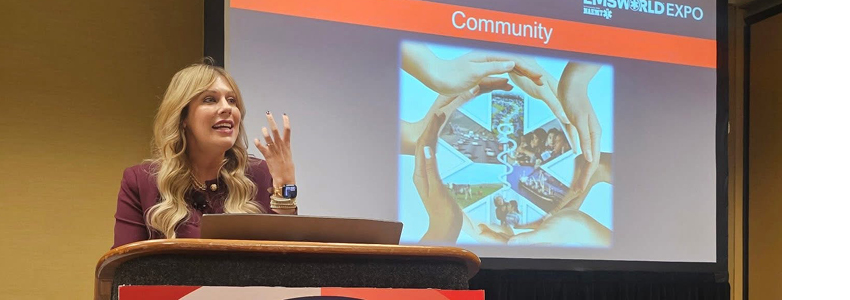
When asked what she hopes people understand about the person behind her story, Liz does not point to her degrees or certifications, the stages she has stood on, or the people who know her name. She talks about something much simpler. “I truly believe we all want to enact some sort of good in life,” she said. “Enact some sort of change. Enact some good. Leave this profession, leave this world, leave anything just a tad better than it was found.”
Even something as small as returning a shopping cart can be part of that, she said, laughing as she explained the idea. The example may seem insignificant, but the belief behind it is not. Liz wants to leave things better than she found them, and she wants the people around her to believe they have the ability to do the same.
That belief is there in the way she teaches her students to see patients differently, in the way she advocates for people who have been stigmatized, and in the way she continues to tell a story that once belonged to the most painful years of her life. “If anything comes out of the freaking 10 years of pure hell and loneliness and despair, and the days that I never even wanted to wake up, if I can make something good out of something so bad and somebody else can learn from that, then that’s all worth it.”
Liz does not deny how dark those years were, and she doesn’t romanticize what she went through. They are part of her story, but they will never define her, and they are not where her story ends.
The Ripple
That may be the most meaningful part of Liz’s story. Years ago, someone looked at her when she could barely see a future for herself and saw something she could not yet see, a human being who was still there, still worthy, and still capable of becoming something more.
Liz has spent the years since then carrying that moment forward. She does it with her patients, with her students, with the Clinicians she teaches, and with the people who hear her story and begin to see addiction, recovery, and even their own work a little differently. She may never know exactly where those moments lead, just as the Paramedic who knelt beside her could never have known where her words would eventually take her.
That is the nature of a ripple. One person chooses to see another person differently, and that moment can travel farther than either of them will ever know. For Liz, that is what makes it all worth it. The difficult years, the recovery, the education, the career, the vulnerability of telling her story, and the hope she now tries to give to others are all connected by the same belief that what happens to us does not have to be where our story ends.
Sometimes, the person who was once given a reason to believe in a future becomes the person who gives that reason to someone else. “There is still life behind those eyes.” Liz knows because someone once saw it in hers.
About the National Registry of Emergency Medical Technicians
Guided by our mission to support the EMS profession through partnerships, research, and lifelong assessment of clinical competence, the National Registry was established in 1970 as a non-profit organization and serves as the Nation’s Emergency Medical Services certification organization. It is accredited by the National Commission for Certifying Agencies (NCCA), the accreditation body of the Institute for Credentialing Excellence. The National Registry maintains NCCA accreditation for each of the four certification programs: Emergency Medical Responder (NREMR), Emergency Medical Technician (NREMT), Advanced Emergency Medical Technician (NRAEMT), and Paramedic (NRP). Credentialing protects the public, assures consumers that Clinicians have met standards of practice, advances the EMS profession, and establishes standards of professional knowledge, skills, and practice. Additional information is available at NREMT.org, and BlueSky, TikTok, Facebook, Instagram, LinkedIn, Reddit, and YouTube.
Media Contact:
Kelly Schroeder
Manager of Integrated Content & Communications
kschroeder@nremt.org